Welcome! Please feel free to subscribe to the newsletter to get studio updates and projects from the archives straight to your inbox.
More than all the world
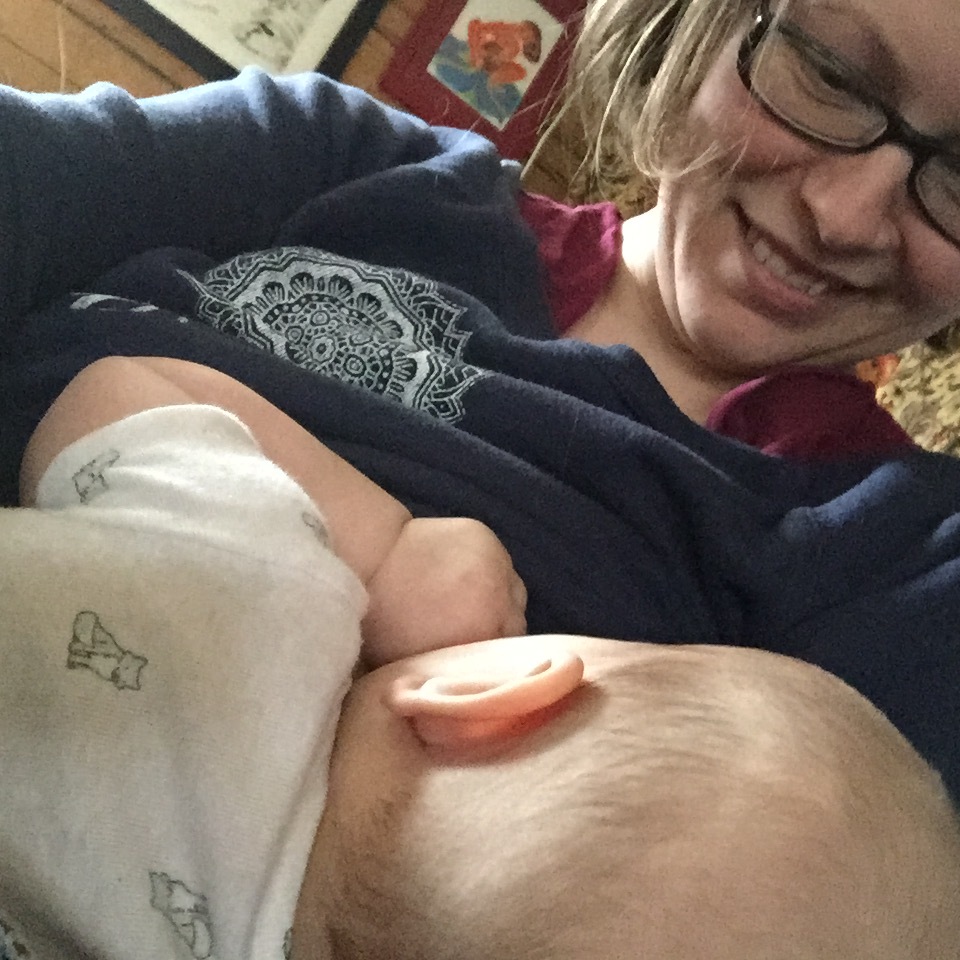
This morning, cuddled up with my babe, gazing down into her cooing smiling face I told her "I love you more than all the world."
In that moment of hearing the words come out of my mouth I realized it wasn't true. The sentiment behind the words burns fiercely in my heart, make no mistake. I love her just as much as I ever dreamed I was capable of loving. And then some.
But this morning I paused. I looked into her wide eyes with the impossibly lush lashes she did not inherit from my genetics, and I told her that it wasn't true. I told her that mama loves her just as she loves all the world. I told her mama loves her to the moon and back, loves her the distance between every star and back. But she is OF this world, and in that moment this morning, I realized with startling clarity that I cannot love her more than that which she is.
This Earth that we live on is a part of us. We are a part of her. The interconnectedness of this web of matter and energy and will and volition is impossibly deep. We speak the deepest of truths when we say "Mother Earth."
“Lokah samastah sukhino bhavantu
-may all beings experience happiness and freedom, and may I contribute in some small part to that happiness and freedom-”
As mothers we are granted visceral access to that space within the human being that has the capacity for unconditional love. It is like a spiritual fast track (advance to go, collect two hundred dollars). Our eyes are primed to see this one small piece of the universe as utterly precious.
As women, whether we choose to bear a child in our womb in this lifetime or not, we contain within us the ability to create new life. To nurture that new life. And to love it unconditionally.
It is our job - our duty, our dharma - to use that gift of perspective, that gift of capacity, that gifted wellspring of unconditional love to encompass all the world. This is how we heal the world.
If we as humans cannot heal from a place of fear - and we cannot; fear stimulates the sympathetic nervous response and its cascade of stress hormones, the physiologic antithesis of the healing process - how can we expect to heal the world from a place of fear? How can we expect to heal the political and personal divides and ailments that fill the news with stories of carnage and heartbreak and horror from a place of fear? How can we expect to heal the imbalances in our climate, halt and heal the destruction of ecosystems and species from a place of fear? Of hopelessness and dread? We cannot. We can only hope to heal the world from a place of love.
As mothers, nay as humans, we bear the sacred capacity to love.
Unconditional love. Love that is without conditions. What would that look like in our world? On a large scale? What - truly - would you see if you were to look at your neighbor, your elected officials, your in-laws, the cashier at the grocery store through the lens of unconditional love? Let's get radical for a moment. What would happen if we saw the refugees flooding Europe with unconditional love? What would happen if we saw the jihadists and terrorists through eyes that love unconditionally? What about the black men and boys that disproportionately fill our prison systems? The welfare mother? The indigenous peoples the world over whose lands are being bulldozed and drilled in the name of progress?
And what would happen if we - globally as humans, locally as people, intimately as women and men - acted from that place of unconditional love?
This is the revolution I would like to see. This is how we heal what is broken and hurting in the world. It is as simple as seeing the ills in our world as tears on the cheeks of an infinitely precious child.
We had this discussion this morning, my daughter and I. Deep spiritual philosophy. She laughed and reached to pull the glasses off my face. Clear vision, indeed. "I love you as I love the world."
What is wet finishing?
Many machine-woven baby wraps are delivered to the customer in loom state and the buyer must do their own initial wet-finishing. Most handwoven baby wraps, and all 14 Mile Farm handwoven babywearing wraps, are delivered to the customer post wet finishing and ready to wear.
Wet finishing is the final step in making a piece of cloth on a hand loom. It is easy to think that the fabric is complete when it rolls off of the cloth storage of the loom, but that is not the case. Handwoven fabric in “loom state” is not yet finished. Wet finishing is the process of washing and drying the woven cloth for the first time.

Bloom shot!
Weaving yarn is (for the most part) spun in industrial mills. The equipment that spins the yarn is lubricated with oil, and this spinning oil ends up lightly coating the spun yarn. The wet finishing process removes this oil, allowing the yarn to ‘bloom.’ As the fabric goes through the process of being washed and dried, the individual fibers in the yarn are able to fluff, shrink, and/or settle into their preferred state.

You can see the way the texture of the fabric changes, and the drape comes into being post-wet finish.
Measurements pre- and post- wet finishing can vary by 10-15% or more. Every yarn and every fiber combination will have different rates of shrinkage. In the case of wool wet finishing must be done carefully, allowing the wool to full (bloom) but not to felt. In general wool should washed in cold water with minimal agitation. Always follow your care instructions!
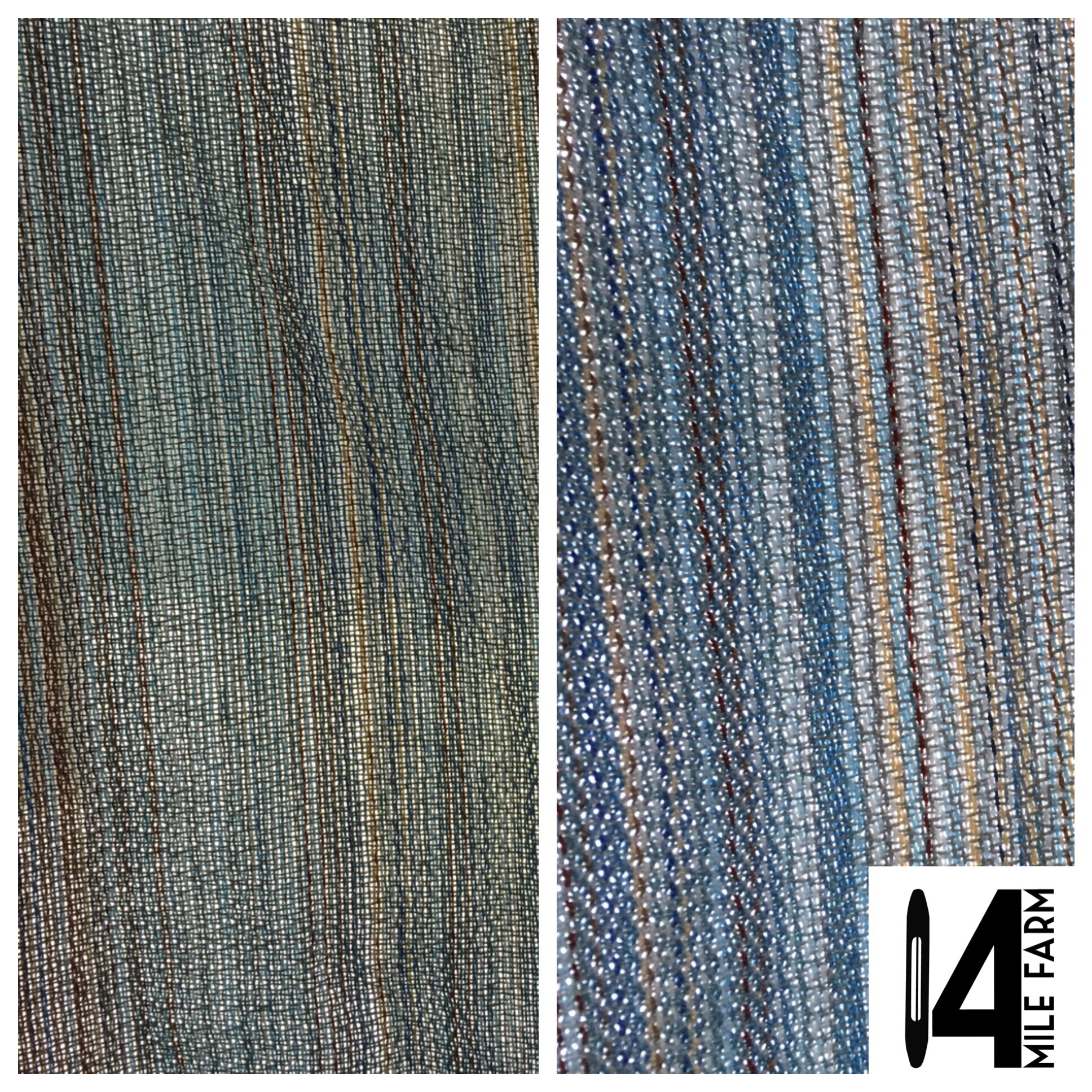
I was surprised by just how much the color of the warp was revealed post wet finishing. You can see the herringbone weave structure more clearly in the second photo as well. Both photos were taken in front of a window in very similar light. This change is due in part to the way that the wet finishing process lets the weft (grey here) really move three dimensionally going over and under the warp threads as it looses the two dimensionality imposed by tension on the loom.
Many machine-woven baby wraps are delivered to the customer in loom state and the buyer must do their own initial wet-finishing. Most handwoven baby wraps, and all 14 Mile Farm handwoven babywearing wraps, are delivered to the customer post wet finishing and ready to wear.
Spark
Spark is a hadwoven babywearing wrap entered into the Spring 2016 Great Competition of Weavers.
In my head, Spark is one classy lady. She shines in pearls and high heels, elegant and poised. She loves a classic ensemble of blue jeans, a white t-shirt, sunglasses, and flats. She’s the kind of woman you admire from afar, wondering how on earth she manages to be all that she is and when you get to know her you are blown away by her kindness, her caring, and her warm hugs.

The Spring 2016 Great Competition of Weavers theme was “Under the Microscope.” This competition was only open to OOAK (one of a kind) wraps, so this is the only piece of Spark there ever was or ever will be. Spark is inspired by the process of mitosis.

As the daughter of a biologist, I have many fond memories of peering into the magical microscopic world contained in a drop of pond water. I was fascinated by “zoomers,” my childhood name for microbes that shot across the slide propelled by cilia or flagella or amoeboid movement. Yeast was particularly cool to watch, because of how FAST they multiplied! Dad was a PhD student in the early ‘90s and did much of his dissertation work on an electron microscope. It lived in its own room down the yellow linoleum hallway and I remember being SO impressed by it and by what could be seen through it. I was 5 years old. I remember the sheer magic of catching a “zoomer” when it was splitting in two, and it was this memory that I hoped to capture with “Spark.”

I considered a black/white/grey grad in homage to the images that we see through electron microscopes, but at least in my memory, the early behemoth of a microscope I stood on a stool to peer into gave a blue cast to its images, and I chose to show this in “Spark.”

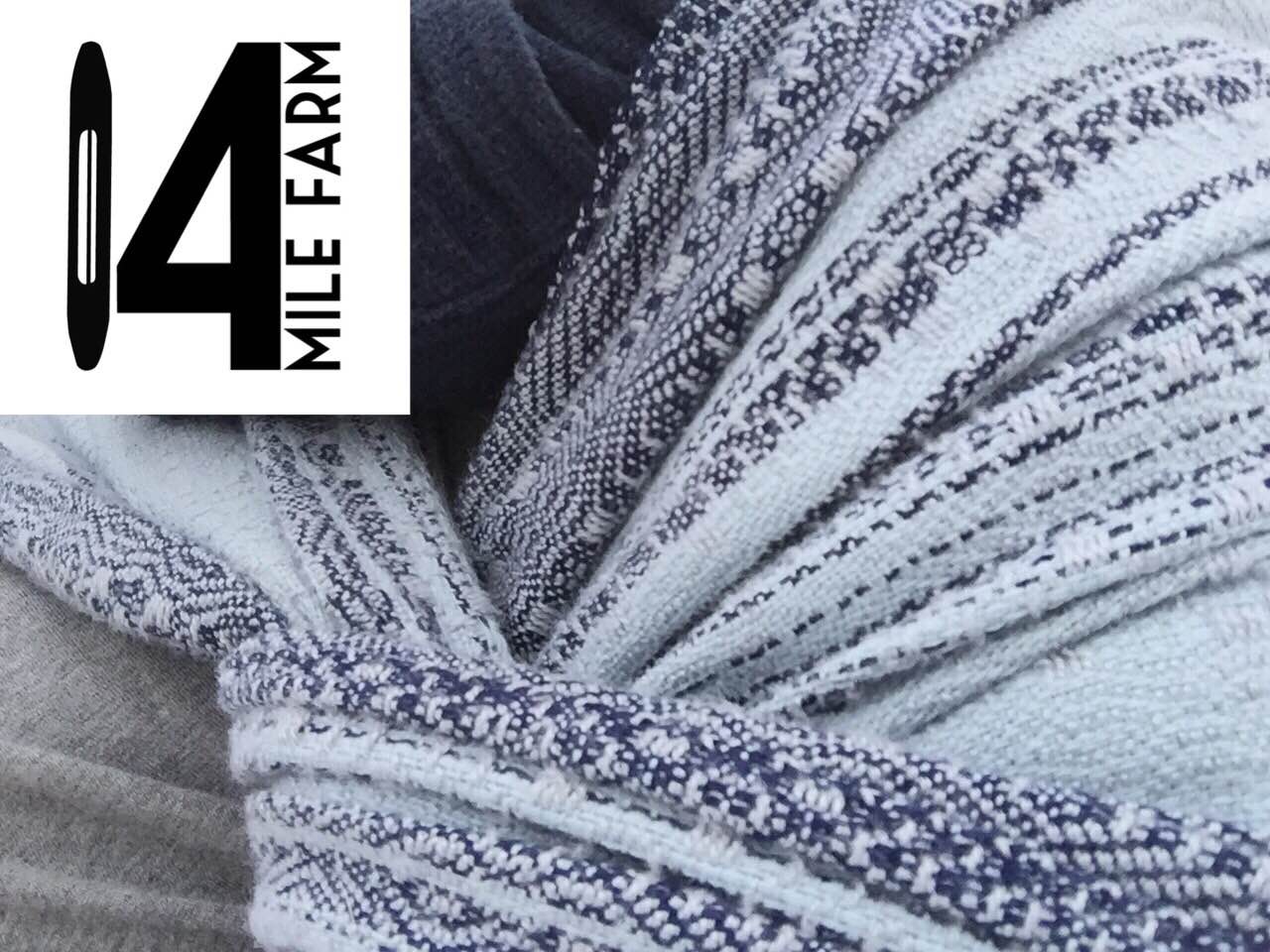
Spark is woven in an overshot variation where the warp intersects with the tabby weft to make a ground of plainweave. In this particular variation there are actually a few picks of basketweave (basically a doubled thread plainweave) in this ground cloth. The pattern weft then floats over this ground to create the pattern. The ground of plainweave means that this is a very strong cloth even though the pattern weft has floats that are longer than would otherwise be optimal for the purposes of a baby wrap.

Funny story: when I first went to look at Maggie (my loom), her former owner – a weaver in her 80’s who had to retire from weaving due to degenerative arthritis in her hands - asked me what I was most excited to weave. I had just learned overshot in my weaving class and had fallen hardcore in love with the weave. I told her that I was most excited to weave overshot. Fast forward 8 or 9 years and this is the first full project that I’ve woven on it in overshot. There are always oh so many tempting projects!

I truly love this structure, and it is super fun and fascinating to see it come to life behind the passing of the shuttles but it is not a quick weave. After each pick, the weaver sets down one shuttle, picks up the other and throws it, making sure that the two wefts stay cleanly wound around each other along the selvedge. I set up my treadles so that my right foot was treadling the plainweave tabby picks, and my left foot was treadling the pattern picks. Each single pattern repeat required 74 steps on the treadles. I believe that I picked up speed the last meter or so, but I was averaging 10 inches per hour. And that’s based on an hour of strict weaving, no pauses to check my phone or nurse a baby or repair a broken thread!

I also love that the process of mitosis – the division and replication of one into two – speaks to this precious era of babywearing. This blink of time when our children are so very little is when they learn to identify themselves as themselves. Early childhood development experts talk about the process of individuation, that babies begin life with a recognition of mom as part of self and have to learn that they are actually two beings. Babywearing allows us to continue holding them as they undergo this transition into independence. The 4th trimester and the concept of the motherbaby dyad are biological and psychological realities that I wish were better understood and recognized by our culture.

Spark’s final measurements are 3.2 m stih weighing in at 280 gsm.She is woven with 16/2 cotton for the warp and tabby weft and 8/2 lyocelle (commonly known as Tencel) pattern weft.
If you are interested in following along more closely as things go onto and come off of my loom, please come join my Facebook group! I also post updates on Instagram.